Cultural Sensitivity Question
Overview
You can choose to add the Cultural Sensitivity question during configuration. This can give you some insight into how consumers view your product or idea, and allows you to catch any issues before you go to market.
It's crucial to approach the interpretation of sensitive or potentially offensive content with empathy and cultural awareness. This type of feedback is largely subjective, but by actively engaging with the feedback and striving to stay attuned to cultural nuances, you can refine your advertising to better align with the values and expectations of your audience, thus building trust and equity for your brand.
How to find it in your report
In Quick ReportsAI
Scroll down to the Resonance section. It may not be included in the Quick Report automatically, so you can add it by clicking the 'plus' to add a section and choose 'Cultural Sensitivity' from the list.
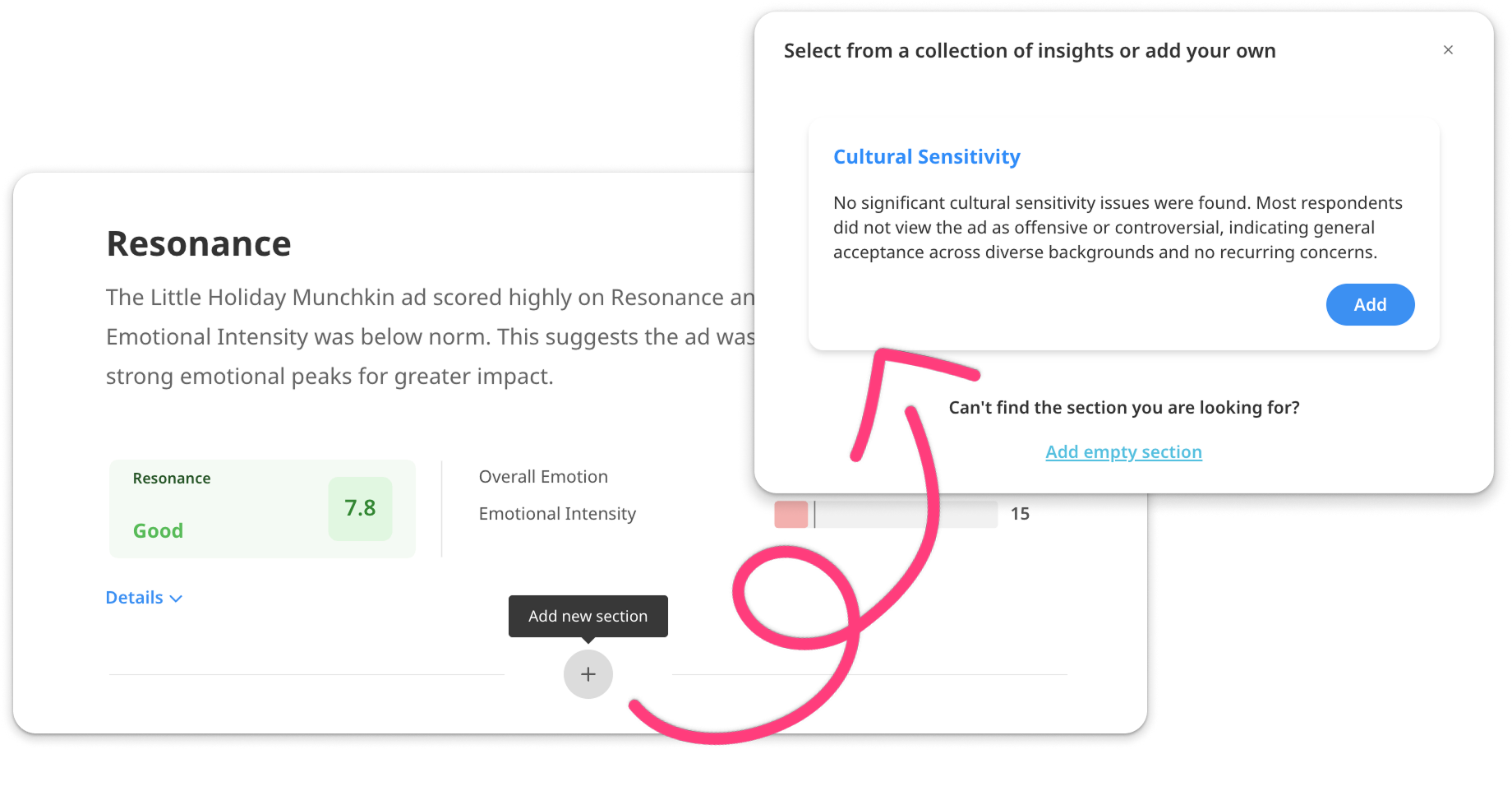
In Charts
Look for Cultural Risks Analysis and Cultural Risks Themes in the Resonance section.
How to analyze the score
Zappi’s Cultural Sensitivity measure is designed to ensure that the content of your creative does not inadvertently offend any group of consumers. It does this by first capturing how many respondents feel that there may be room for any people to find the stimuli offensive, unpleasant or disturbing. We then ask those respondents what it is that they believe people may find offensive, unpleasant or disturbing.
No norm or benchmark is associated with this measure.
Any number greater than zero should be evaluated, and all comments from respondents should reviewed. Ideally, these comments should be reviewed by a cross-section of the communities represented in the population for which the stimuli was tested.
- The measure is itself a projective exercise. We do not ask respondents what they find offensive - instead we ask them if there is anything that they think others may find offensive. The data that we collect for this measure can therefore be somewhat speculative.
- For example, if an ad uses dry humor, then it is possible that while no respondents find the ad offensive themselves, they may speculate that others will. This means ads that pursue a certain strategy may get higher scores for this measure as a result of that creative strategy.
- Groups that may find something offensive vary in size. Different groups are likely to react to this measure in different ways, depending on the specifics of the stimuli being tested. Zappi uses stratified samples via weights and quotas to represent the populations of each of the markets that fieldwork is conducted in. It is possible that the specific communities that may find a reason to find an ad offensive will vary in size.
- If the offensive aspect of the stim is noticed by only one community, such as the Asian population (roughly 6% of the US population, the proportion of respondents reporting that an ad has potential for offense may only make up about 6% of respondents. That doesn't mean the stim has any smaller chance of being offensive, it's just noticed by a smaller group.
For these reasons, we recommend that any Cultural Sensitivity Check score greater than zero trigger a closer look at the verbatim.
How to analyze the verbatim
Cultural sensitivity is subjective, so we recommend drawing on these best practices when sensitive content has been flagged by respondents:
- Be sure to assess the severity of the perceived offense, as well as the breadth. Some feedback may highlight minor cultural misunderstandings or preferences, while others may point to genuinely harmful or disrespectful content. Some may be mentioned only once or twice, or some may be mentioned by most who responded. Take the time to understand the specific aspects of the stim that triggered the offense and whether they align with widely accepted cultural norms.
- Negate the risk of unconscious bias or the lack of cultural context of a single user. If you are analyzing on behalf of a market that you do not personally live in, or analyzing an advertisement geared toward an audience of which you don’t belong or identify, we recommend supplementing your analysis with that of a colleague or consultant living within the local market or target audience.
- Prioritize transparency and accountability in your decision-making process. By communicating openly with stakeholders about the feedback received, it could be that an open and thorough review of the content in question leads to only minor adjustments to mitigate offense, without compromising the overall message.