Effective Discount
Overview
Your wallet can hold multiple credit bundles from different purchases or top-ups, each potentially carrying a different discount percentage. The effective discount is the single percentage that reflects the combined discount you actually received on a given purchase, calculated from which bundles and how much of each were used
How it works
Credits are always used in expiry order. The credits closest to expiring are spent first. This protects you from losing credits that are about to expire.
A simple example
You're making a $2,500 purchase and your wallet has:
| Bundle | Balance | Discount | Expires |
| A | $1,000 | 10% | Soonest |
| B | $1,000 | 15% | Next |
| C | $1,000 | 20% | Latest |
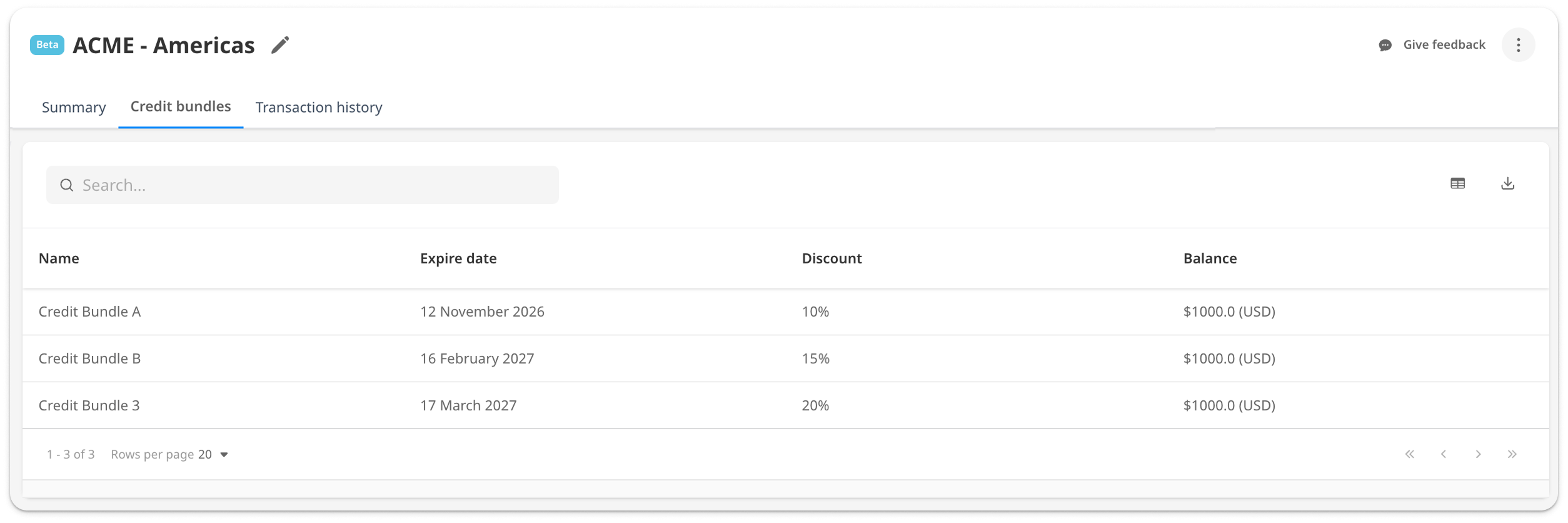
The system draws from each bundle in expiry order until the purchase is fully covered. After applying each bundle's discount, you end up paying $2,169.94, meaning you saved $330.06, for an effective discount of 13.20%.
You’ll notice that 13.20% isn't a simple average of 10%, 15%, and 20%, it reflects the actual proportion of the purchase covered by each bundle.
If one credit bundle has no discount and another credit bundle has 10%, that is still considered multiple discounts.
Discounts on Mixed Orders
Some orders contain a mix of discountable and non-discountable items. For example, the cost of running a project can be discounted, but extra service fees, such as consultancy services are excluded from any discount.
For these mixed orders, payment is processed in two parts:
- Non-discountable items are charged first at full price, with no discount applied.
- Discountable items are charged second, with the effective discount calculated based on the remaining credit balance.
The effective discount percentage is determined by the total value of the non-discountable items in the order, and is then applied to the discountable line items as usual.
What if my credits don't cover the full purchase?
The effective discount still applies to the portion your credits do cover. For example, if you have $100 in credits at a 10% discount and you're making a $10,000 purchase, the effective discount on the overall transaction would be 0.11% - small, but your discount was still applied and you saved money on that portion.
The bottom line
The effective discount answers one question:
How much of a discount did I actually get on this purchase?
It accounts for all your credit bundles, their respective discounts, the order they were used, and how much of each was spent, rolled into one precise percentage.
If you want a deep dive on the math behind the discount, watch this video.