Optimize Pack | Changes
Overview
We're making meaningful improvements to Optimize Pack in early January - helping you create packaging that stands out on the shelf, fits your brand, and gets shoppers to choose your product.
Here's what's new:
- New behavioral metrics to assess how well your pack stands out and drives purchase: Our improved Lite Shelf module now measures Purchase Choice, Stand Out, and Findability in the context of your competitive set.
- Better brand fit assessment: We're adding insights on unaided Brand Recall, Distinctive Brand Assets, and Brand Believability so you can ensure your pack is on brand.
- Stakeholder-ready reporting with AI Quick Reports: Quickly surface key takeaways and implications, delivering around 80% of the analysis in about 1% of the time.
- Streamlined reporting in Charts: Now with 40% fewer charts, a clearer flow, actionable descriptions, and better visuals. You get richer insights in a more digestible, easier-to-action format.
- A smoother survey experience: We've improved how we profile respondents, made questions more intuitive, and removed low-value questions for more actionable results.
How does this affect existing projects?
When the update goes live, your past Optimize Pack projects will stay exactly where they are, but parts of the reporting experience will change to reflect the improved survey and charting.
Here's what that means:
- Some charts will disappear because we removed low-value questions. The data still exists in Crosstab, Data, and Exports as raw data (without norms).
- The current calculation scores, Pack Driven Shelf Impact, Sustainability Score, and Communication Score, won’t be available at all after January 2nd. Going forward, you can look at the simpler and more powerful expression of these scores: Distinctiveness, Sustainability, and Pack Communication.
- Default norms will update to provide a better benchmark based on whether you run a study with or without the shelf module - but you can still switch back to the previous norm set (which combines shelf and non-shelf studies).
- To keep current chart views, download them before January 2nd, 2026. For help, go to our Export Help article.
All meaningful metrics for past studies will stay within Charts. This is a necessary reporting update to match the improvements we’re introducing and give you more actionable reporting going forward.
If you want to keep the visual expression of the removed metrics and Summary Scores for past studies, download the charts before January 2nd 2026. For help, go to our Export Help article.
Survey Changes
We added new questions to get better insights, improved wording and profiling, and removed questions that did not add significant value or were redundant.
New Questions
| Lite Shelf - optional in-context module | Main Survey | Profiling |
|---|---|---|
|
Purchase Choice - a behavioral in-context measure commonly used in pack research, provides a read on pack’s power to drive purchase in competitive context |
Purchase Likelihood - a key measure of success / pack’s ability to drive purchase, it replaces Purchase Likelihood if Usual Product Not Available as a stronger and more versatile measure. |
Brand Purchase Frequency - understanding how your new design resonates with brand buyers vs non-brand buyers, and how that differs based on how frequent the buyers are will help you make better decisions, aligned with your pack (re)design objectives. This question enables you to filter the results in this way. |
| Reasons for Purchase Choice - a diagnostic measure commonly used in pack research | Distinctive Brand Assets - consistent use of distinctive brand assets is a key driver of brand success - we added this diagnostic to help brands understand whether they’re using their distinctive brand assets effectively | Brand Usage - similar as above but here you’re able to filter based on which brands consumers bought and hence understand interaction of your new design with buyers of your competitive set |
| Stand Out - a behavioral measure that provides a read on pack’s power to stand out in competitive context (and an alternative to Time to Find used by IPSOS & Behaviorally) |
|
|
| Findability - a behavioral measure standardly used in pack research to understand whether consumers can easily recognize the product (especially useful when testing new line extensions alongside existing ones, as they can be less differentiated) |
|
|
Changed Questions
Changes with reporting & configuration impact
| Unaided Brand Recall | Originally reported as a word-cloud, we’re switching to quantified reporting with brand recall percentage. This change requires additional inputs during configuration. |
|---|---|
| Pack Emojis | We’re changing to Overall Emotion used in other Zappi solutions to enable better insights and more visual reporting. |
| Believability | We’re changing this question to Brand Believability which is a more relevant diagnostic for packaging. This will result in Believability not appearing in the new charts for previous studies. |
Minor changes with no reporting & configuration impact
| Product most likely to purchase |
Shelf Module Transformed into Purchase Choice. Results for past studies on this question are still in Charts. |
|---|---|
| Prompted Recall |
Shelf Module Changed the options list from images to text only to make it a stronger way to ask the question. |
| Brand Linkage | Improved the wording with no impact on norms. |
| Package side panel | Changed to ‘Alternative Pack View’ to make the wording more versatile |
| Package back panel | Changed to ‘Alternative Pack View 2’ to make the wording more versatile |
| Pack Communication 1 | Changed to Pack Communication since Pack Communication 2 has been removed. |
| Attributes Association | Changed to Attributes for simplicity. |
| Sustainable package believability | Changed to Sustainability for simplicity. |
Unchanged Questions
| Optional Shelf Module | Spontaneous Recall |
|---|---|
| Main questionnaire - metrics | Overall Appeal, Influence on Purchase, Distinctiveness, Advantage, Brand Feeling, Cultural Sensitivity |
| Main questionnaire - diagnostics | Heatmaps, Ideas for Improvement, Key Message, Cultural Sensitivity |
Removed Measures
We found that some questions did not add value in a way we wanted for the updated Optimize Pack. For each question that was removed, we made sure to replace it with more optimized questions.
| Lite Shelf Optional In-Context Module | Main Survey | Profiling |
|---|---|---|
|
First thing to catch attention - Replaced by Reasons for Purchase Choice (open end) and Stand Out (behavioral). |
Purchase Likelihood if usual product not available - Replaced by a new, stronger Purchase Likelihood question. The impact on Purchase Likelihood metric remains as another indicator of pack’s potential to drive purchase (with current norms available). |
Retailer visit - Merged Retailer Visit and Category Retailer Visit questions into one question that asks about retailer visit when buying the category. Without the category lens the question was less relevant. |
| Other things to catch attention - Replaced by Reasons for Purchase Choice (open end) and Stand Out (behavioral). | Brand Emojis - Removed as a low-value metric that wasn’t used much. The strengthened branding module is a more relevant way to assess brand impact, plus, Pack Emojis are available to assess packaging impact. | Retailer engagement and Category retailer engagement- Merged the Retailer Engagement and Category Retailer Engagement questions into one question that asks about how respondents purchase the category (in-store/online). Without the category lens the question was less relevant. |
| Products likely to purchase (multi-choice) - Replaced by an in-context Purchase Choice (behavioral, single-choice), as a stronger metric. | Ease of find on shelf - Replaced as it is less valuable as assessed out of context. Distinctiveness remains as a key indicator of stand out (with current norms available) plus new in-context behavioral metrics were added to assess shelf stand out - Stand Out and Findability. | Pre-exposure brand choice - Replaced by a stronger Brand Usage question. We also added a Brand Purchase Frequency question for the target brand. |
| Never purchased products - Replaced by an in-context Purchase Choice (behavioral single-choice), as a stronger metric. | Environmentally friendly package - Redundant metric as it correlated highly (R2>0.8) with the Sustainability metric which remains (with norms). |
|
|
|
Pack communications 2 - Redundant metric as it correlated highly (R2>0.8) with Pack communication 1 metric which remains (with norms). |
|
|
|
Functionality questions: These optional questions were used infrequently (<5% of surveys) and they complicated the configuration. These questions can be still asked as part of the Attributes question.
|
|
Reporting Changes
AI Quick Reports
AI Quick reports will be available for all new surveys run after January 6th. By combining human expertise with advanced AI analysis, Quick Reports deliver a concise summary of research results and key diagnostics within moments. This feature allows you to skip the complexities of data interpretation and jump straight into actionable insights.
Learn more about AI Quick Reports.
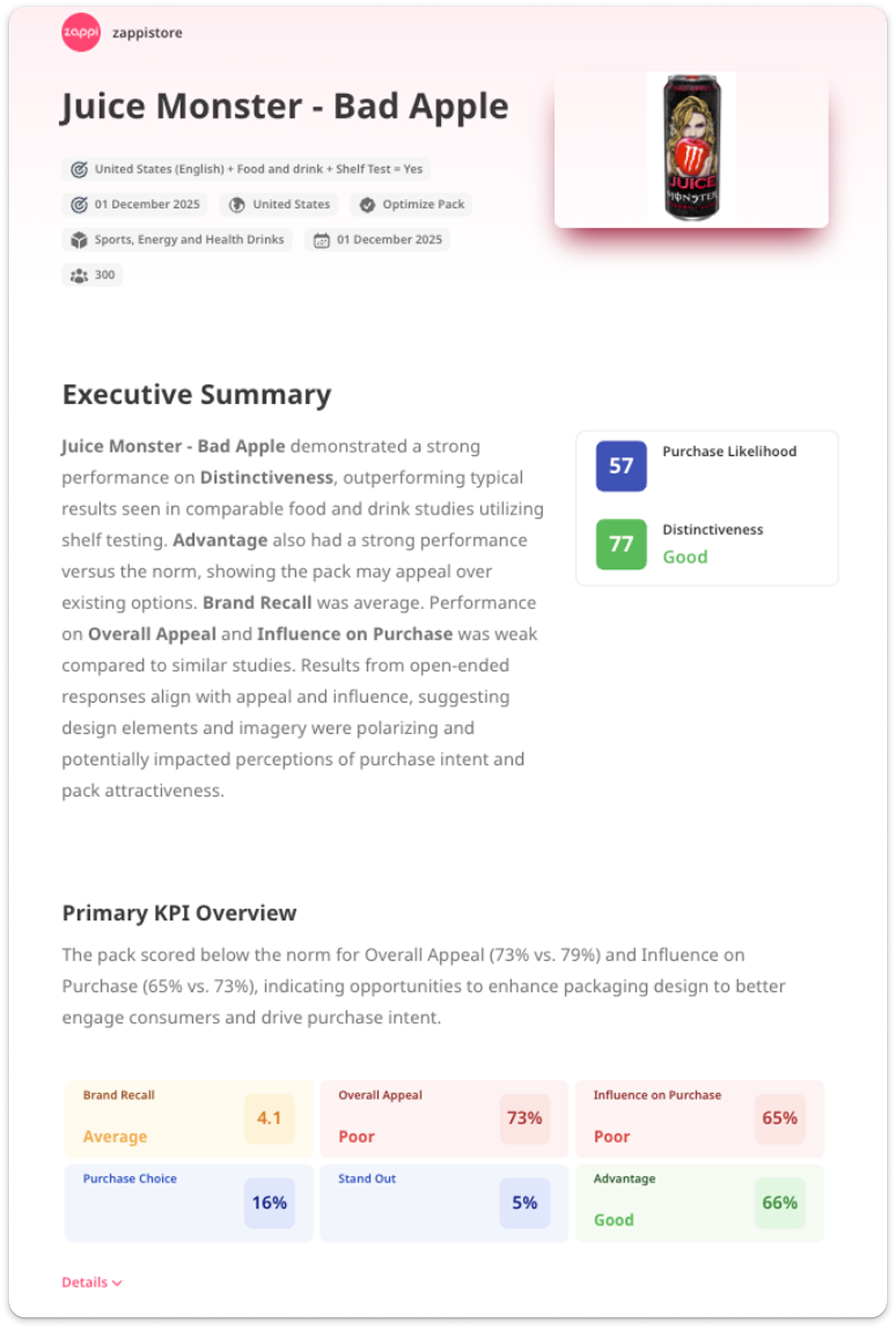
Improved charts
Charts will be more intuitive and have a simpler flow (40% less charts). We’re giving them more actionable descriptions, better visualizations and providing more relevant metrics and diagnostics overall.
- Improved branding section - We’re reporting on Unaided Brand Recall as a percentage of total respondents, Distinctive Brand Assets are a separate diagnostic. Brand Linkage, Feeling and Believability are metrics.
- Lite Shelf - optional in-context section - now includes the new behavioral metrics of Purchase Choice, Stand Out, and Findability in the context of your competitive set, alongside spontaneous and prompted recall that were previously available.
- Streamlined, more intuitive flow and charts - We’re combining individual metric charts into one, using more visual chart types .
- Removing confusing summary metrics such as pack driven shelf impact, sustainability score, and communication score.


Changes to Default Norms
Separate norms for in-context (shelf module) and no-context surveys
- Optimize Pack will have norms based on previously collected data, meaning there’s no wait time while a new norm is built.
- The new default norm will be a shelf or no-shelf depending on how the survey was run which results in a better benchmark. You can switch to a joint norm if you want to look at previous results or don’t have a norm available.